

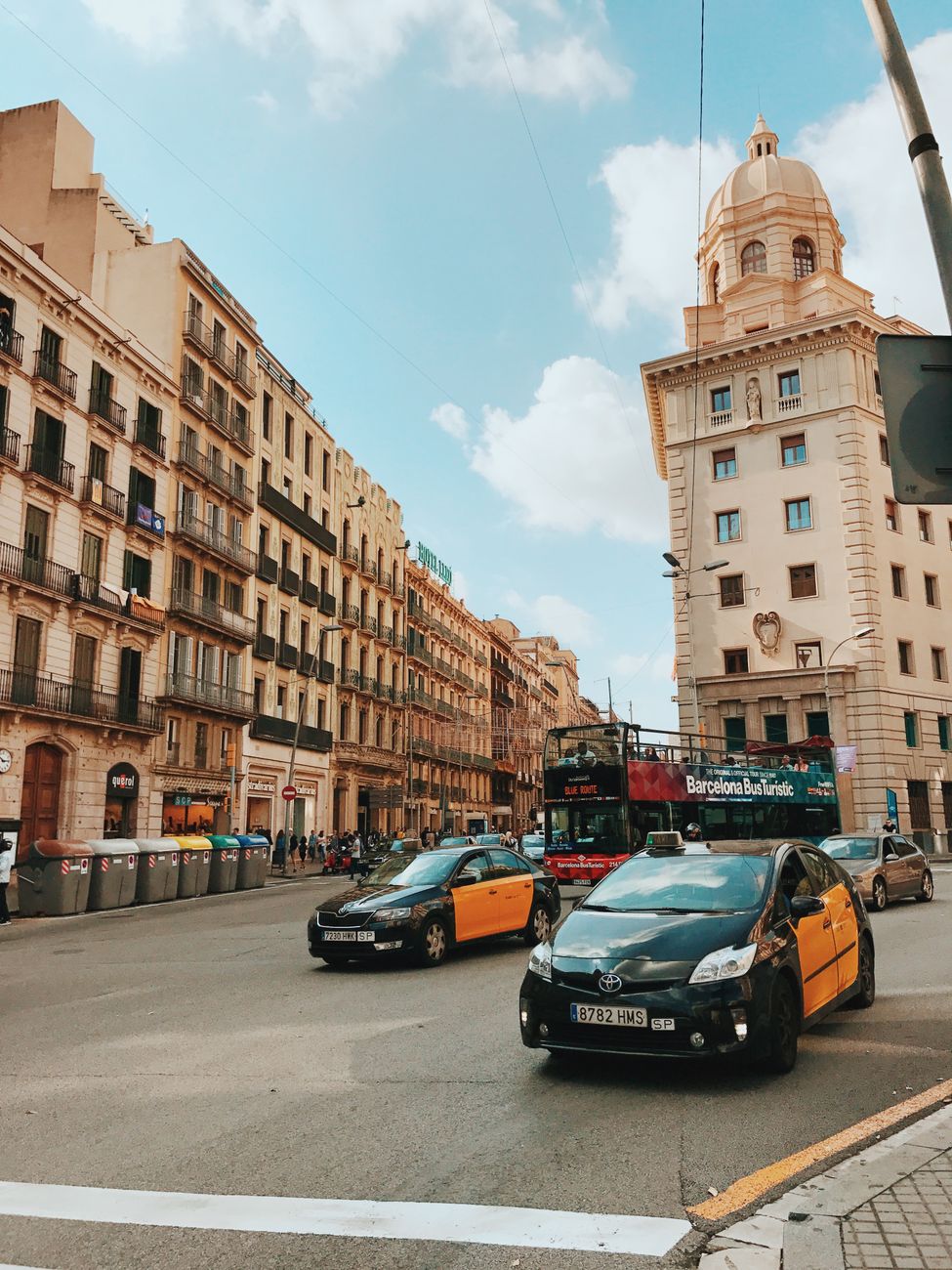
The Iconic Black-and-Yellow Colour Scheme
The single most recognisable feature of an official Barcelona taxi is its distinctive black-and-yellow paintwork. The body of the vehicle is black, and the roof is painted a bright, unmistakable yellow. This two-tone combination is unique to Barcelona and has been the city’s standard taxi livery for decades. If a vehicle does not display this specific colour scheme, it is not an official Barcelona city taxi, regardless of what the driver tells you.
It is worth noting that some vehicles operating under different regional or metropolitan licences may look superficially similar, but the black-and-yellow combination is specific to taxis licensed by IMET for Barcelona city and the metropolitan area. When you exit any terminal at Barcelona–El Prat Airport, look for this colour immediately. Do not enter any vehicle that is entirely white, silver, black or any other single colour, even if the driver claims to be an official taxi. The colour scheme is non-negotiable for licensed operators, and any deviation is a red flag.
What About Accessible Taxis?
Some accessible taxis in Barcelona — vehicles equipped with ramps or lifts for wheelchair users — may have a slightly different appearance due to their larger body type, but they will still carry the black-and-yellow livery along with additional accessibility markings. These vehicles are part of the official fleet and are subject to the same licensing requirements as standard taxis.
The Illuminated Roof Light and What It Tells You
Every official Barcelona taxi is fitted with a green or white illuminated sign on the roof. When the taxi is available for hire, this light is switched on. When the taxi is occupied or off duty, the light is switched off or may display a red indicator. This is a simple but reliable signal that tells you at a glance whether a cab is free before you attempt to flag it down.
The roof sign typically displays the word “TAXI” and is positioned centrally on the roof of the vehicle. Some signs also include a small number that corresponds to the taxi’s licence plate or registration number. If a vehicle has no roof light at all, or if the roof light is a makeshift or non-standard design, treat this as a warning sign. Legitimate taxis in Barcelona are required to have a standardised, functioning roof light as part of their operating licence.
Licence Plates, Stickers and Official Identification Markings
Beyond colour and roof lights, official Barcelona taxis carry several mandatory identification markings. On the rear of the vehicle, you will find a licence plate specific to taxi operations, which differs from standard private vehicle plates. Each taxi also displays a municipal licence number, usually shown as a small sticker or plate on the rear window or door. This number is registered with IMET and can be used to file a complaint or verify the vehicle’s legitimacy.
On the doors of the vehicle, you will typically see the official Barcelona taxi logo or crest, along with the licence number. Inside the taxi, the driver is required to display their driver identification card in a visible location, usually mounted on the dashboard or the back of the front seat. This card includes the driver’s photograph, name and licence number. If you cannot see this card, you are entitled to ask for it, and a legitimate driver will produce it without hesitation.
The Taximeter: Your Guarantee of a Fair Fare
Every official Barcelona taxi must be fitted with a tamper-proof, officially calibrated taximeter. The meter must be clearly visible to the passenger at all times and must be activated at the start of every journey. The meter displays the running fare in euros and will show the applicable tariff — Tariff 1 for daytime journeys within the city, Tariff 2 for night-time and weekend journeys, and Tariff 3 for journeys to or from the airport and certain out-of-city destinations.
If a driver refuses to use the meter or proposes a fixed price that has not been officially agreed in advance, this is a serious warning sign. The only legitimate fixed fares in Barcelona taxis are those established by regulation, such as the flat rate for airport journeys. Always confirm that the meter is running before the journey begins, and keep an eye on it throughout the trip.
Official Taxi Ranks: Where to Find Legitimate Taxis
Official Barcelona taxis operate from designated ranks (parades de taxi) located throughout the city. At Barcelona–El Prat Airport, there are dedicated taxi ranks immediately outside the arrivals halls of both Terminal 1 and Terminal 2. These ranks are clearly signposted and staffed by rank marshals during busy periods. You should always join the queue at the official rank rather than accepting a ride from someone who approaches you inside the terminal building or in the car park.
In the city centre, official taxi ranks are found outside major train stations including Barcelona Sants, Passeig de Gràcia and Arc de Triomf, as well as outside the main cruise terminals at the Port of Barcelona. You can also hail a taxi from the street when the roof light is green, or book one through the official apps provided by Barcelona taxi cooperatives. Using an official rank or app eliminates any ambiguity about the vehicle’s legitimacy.
Comparing Your Transport Options in Barcelona
Understanding the official taxi system is more useful when you can compare it to your other realistic options. The table below outlines the main choices for travellers arriving at or departing from Barcelona.
| Option | Typical Use Case | Pricing | Booking Required | Notes |
|---|---|---|---|---|
| Official Barcelona taxi | Short to medium city trips | Metered (regulated) | No | Black-and-yellow, IMET licensed |
| Private transfer (e.g. TransferBCN) | Airport, port, hotel door-to-door | Fixed, agreed in advance | Yes | Flight monitoring, child seats, groups |
| Aerobús (airport bus) | Airport to Plaça Catalunya | Fixed, low cost | No | No luggage assistance, shared service |
| Metro (L9 Sud) | Airport to city stations | Fixed, low cost | No | Limited luggage space, no direct centre route |
| Ride-hailing apps | Flexible city travel | Variable | Yes (via app) | Not always licensed as taxis |
For travellers with large amounts of luggage, families with young children, or groups of four or more, a pre-booked private transfer often makes more practical sense than waiting at a taxi rank. Services like TransferBCN offer fixed pricing confirmed before you travel, meet-and-greet at the arrivals hall, and vehicles suited to different group sizes. For solo travellers or couples making short city trips, an official taxi from a designated rank is a perfectly reliable and straightforward option.
Practical Advice for Families, Groups and Accessibility Needs
Families travelling with young children should be aware that official Barcelona taxis are legally required to carry child seats upon request, though availability can vary and advance notice is not always possible when hailing a cab from the street. If you have an infant or toddler, pre-booking a private transfer with a confirmed child seat is the more reliable approach. Standard taxis can legally carry up to four passengers, so larger families or groups may need two vehicles.
Travellers with mobility impairments or wheelchair users should look for the accessible taxi fleet, which operates under the same IMET licensing and uses the same black-and-yellow livery. These vehicles can be requested through official taxi apps or by calling the dedicated accessible taxi phone line. At the airport, inform the rank marshal of your accessibility requirements and they will direct you to the appropriate vehicle. If you need a guaranteed accessible vehicle at a specific time, pre-booking through a private transfer provider is the most dependable solution.
Common Mistakes Travellers Make and How to Avoid Them
One of the most frequent mistakes made by first-time visitors is accepting a ride from someone who approaches them inside the airport terminal. Legitimate taxi drivers do not solicit passengers inside the building — they wait at the official rank outside. Anyone who walks up to you in the arrivals hall offering a “taxi” or “private transfer” at a fixed cash price should be politely declined.
A second common error is assuming that any vehicle with a “TAXI” sign is official. Unofficial operators sometimes use roof signs that superficially resemble the real thing but lack the proper markings, licence numbers and the correct black-and-yellow livery. Always check the full combination of colour, roof light, door markings and interior driver ID card before entering. A third mistake is not asking for a receipt. Official taxis are required to provide a printed receipt upon request, which includes the journey details, fare, licence number and date. This receipt is essential if you need to make a complaint or have left something in the vehicle.
How to Report a Problem with a Barcelona Taxi
If you believe you have been overcharged or treated improperly, note the taxi’s licence number (displayed on the door and inside the vehicle) and the driver’s ID number. You can file a formal complaint with IMET through their official website or at the taxi rank office at Barcelona–El Prat Airport. Keeping your receipt makes this process significantly easier.
Booking and Timing Advice for Airport Journeys
The journey from Barcelona–El Prat Airport to the city centre takes approximately 25 to 45 minutes depending on traffic, time of day and your specific destination. Rush hour in Barcelona typically runs from 07:30 to 09:30 in the morning and from 17:30 to 20:00 in the evening on weekdays. If your flight arrives during these windows, expect longer journey times and potentially longer queues at the taxi rank.
If you are travelling during a major event — such as the Mobile World Congress, Primavera Sound or a Champions League match at the Estadi Olímpic — demand for taxis at the airport can be exceptionally high. In these situations, pre-booking a private transfer is strongly advisable. Services like TransferBCN monitor your flight in real time, meaning your driver adjusts to any delay or early arrival without you needing to make contact. This level of reliability is difficult to replicate when relying on a rank taxi during peak demand.
FAQ: Official Barcelona Taxis
What colour are official Barcelona taxis?
Official Barcelona taxis are black and yellow. The body of the vehicle is black, and the roof is painted bright yellow. This colour scheme is unique to Barcelona’s licensed taxi fleet and is regulated by IMET. No other vehicle type in the city uses this combination, so it is your most reliable first indicator when looking for a legitimate cab.
How do I know if a Barcelona taxi driver is licensed?
Every licensed driver must display an official identification card inside the vehicle, typically on the dashboard or the back of the front seat. The card includes the driver’s photograph, full name and licence number. You can also check the door of the vehicle for the municipal taxi licence number. If either of these is missing or the driver refuses to show ID, do not travel with them.
Is there a fixed fare from Barcelona Airport to the city centre?
Yes, there is a regulated flat rate for taxi journeys between Barcelona–El Prat Airport and destinations within the city of Barcelona. This fare is set by the metropolitan authority and covers the journey regardless of traffic conditions. The exact amount is subject to periodic revision, so verify the current rate with IMET or ask your driver to confirm before the journey begins.
Can I hail an official Barcelona taxi from the street?
Yes, when the roof light is illuminated (green or white), the taxi is available for hire and you can flag it down from the pavement. You can also find taxis at official ranks throughout the city, outside major transport hubs, hotels and tourist attractions. Alternatively, several official taxi cooperatives offer booking apps that allow you to request a vehicle to your location.
Are Barcelona taxis safe for solo female travellers?
Official Barcelona taxis are regulated and subject to strict licensing requirements, making them a generally safe option for all travellers including solo women. The driver ID card displayed inside the vehicle means every journey is traceable. For additional peace of mind, note the taxi’s licence number before you depart, share your journey details with someone you trust, and request a receipt at the end of the trip.
What should I do if a taxi driver tries to charge me more than the meter shows?
You are only legally obliged to pay the amount shown on the taximeter, plus any officially approved supplements (such as for luggage or airport journeys). If a driver demands more, ask for a receipt and note their licence number. You can then file a complaint with IMET. Do not hand over cash without receiving a receipt, and if you feel unsafe, you can ask to be dropped at a public location before resolving the dispute.
What is the difference between an official taxi and a private transfer in Barcelona?
An official taxi is a metered, street-hailable vehicle regulated by IMET. A private transfer is a pre-booked service with a fixed price agreed before travel. Private transfers, such as those offered by TransferBCN, typically include meet-and-greet service, flight monitoring, fixed pricing, and vehicles suited to groups or families. Taxis are ideal for spontaneous, shorter journeys; private transfers are better suited to airport pickups, large groups and travellers who value certainty.
Conclusion: Travel Confidently in Barcelona
Recognising an official Barcelona taxi comes down to a clear set of visual and procedural checks: the black-and-yellow livery, the illuminated roof sign, the door licence markings, the driver ID card inside the vehicle, and the running taximeter. When all of these elements are present, you can board with confidence. When any of them are missing, trust your instincts and find an alternative.
For travellers who prefer to remove all uncertainty from the equation — particularly for airport arrivals, early morning departures, family trips or group travel — TransferBCN offers a straightforward alternative. With fixed prices confirmed at the time of booking, real-time flight monitoring, professional drivers and vehicles tailored to your group size, a private transfer takes the guesswork out of getting from the airport to your hotel and back. Visit TransferBCN to get a quote for your Barcelona journey before you travel, and arrive knowing exactly what to expect from the moment your flight lands.