

Quick answer: you can get a taxi in Barcelona four ways — hail one on the street (look for the green roof light), find one of 300+ official ranks, call a radio taxi cooperative by phone, or book through an app like FreeNow. Fares are metered by law (from €2.80, plus €1.35–€1.66/km). The airport run to the city center costs €35–45 including the mandatory €4.60 supplement. For groups, late flights, or a child seat, a pre-booked fixed-price transfer is more predictable than the meter.
Barcelona has one of the most regulated taxi fleets in Europe: over 10,000 licensed cabs, metered fares set by law, and a rank on practically every major corner. If it’s your first time here, the question isn’t whether you’ll find a taxi — you will — it’s whether you hail, call, or book through an app, and what that choice actually costs you.
This guide covers all four ways to get a taxi in Barcelona, what each one costs, and where a pre-booked transfer beats a street hail outright.
How to Recognize an Official Barcelona Taxi
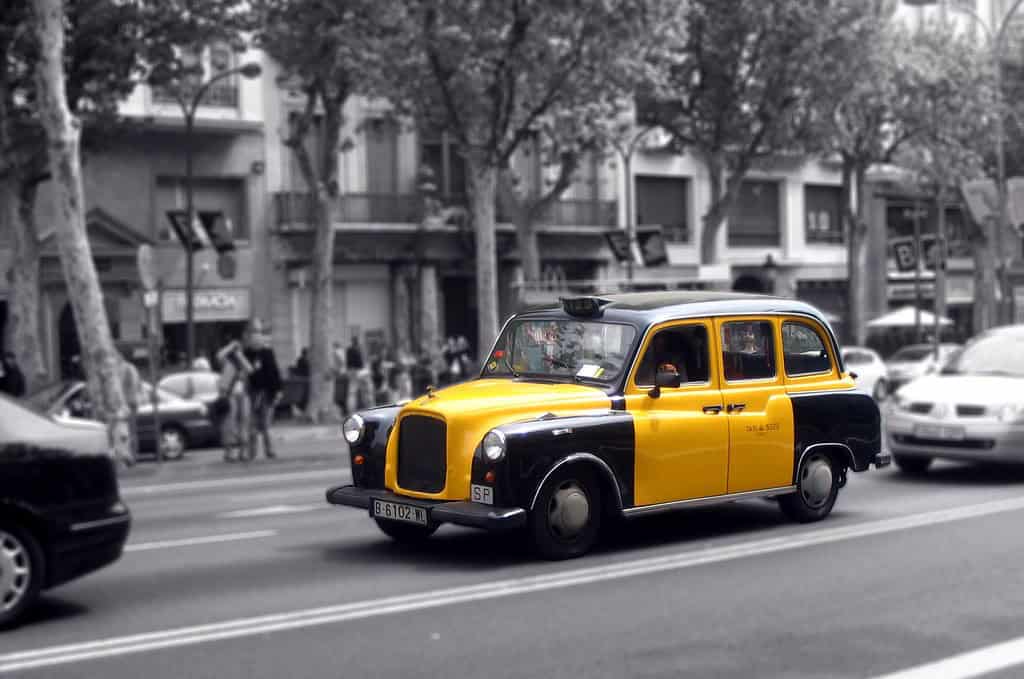
Official cabs are black with a yellow stripe down the doors. Every legal taxi carries three things:
- A roof sign that shows green when free, red when occupied
- A visible licence number inside the vehicle
- A working taximeter, in plain view of passengers
No roof sign, no meter, no ride — especially around the airport and Sants station, where unlicensed drivers sometimes approach tourists directly before they’ve cleared arrivals.
4 Ways to Get a Taxi in Barcelona
1. Hail One on the Street
The simplest method in the city center. Spot the green light, step to the curb, raise your arm. Works well on wide avenues like Passeig de Gràcia or Gran Via — less well on the narrow one-way streets of the Gothic Quarter, where a taxi physically can’t reach you.
2. Find a Taxi Rank (“Parada de Taxi”)
Barcelona runs 300+ official ranks, marked with a blue “Taxi” sign, outside airports, train stations, major hotels, and tourist landmarks — including one directly outside Sants station. Ranks are the safer bet late at night or anywhere hailing is impractical.
3. Call or Book by Phone
Barcelona’s radio taxi cooperatives dispatch a cab by phone, usually within 5–10 minutes. This is also the required route if you’re a group of more than four, since a standard taxi is licensed for four passengers only.
4. Book Through an App
The most predictable option: you see the fare before you commit, and you can track the car in real time. This is what most first-time visitors default to once they know the options.
Barcelona Taxi Apps: FreeNow, Cabify, Uber, and More
- FreeNow — the taxi-specific app most used in Barcelona. Books licensed taxis directly, shows the fare upfront, takes card or Apple Pay in-app.
- Cabify — a step more premium, mixes licensed taxis with private drivers, includes real-time trip sharing.
- Uber — does operate here, but mostly by connecting you to licensed taxi drivers rather than private UberX cars, which are tightly restricted in Catalonia. It works. It’s just not your fastest option — treat it as a third choice behind FreeNow and a plain street hail.
- Área Taxi / Taxi Ecològic — smaller, Barcelona-specific apps; Taxi Ecològic runs hybrid and electric vehicles if that matters to you.
How Much Does a Taxi Cost in Barcelona?
Fares are metered and set by the Institut Metropolità del Taxi (IMET), so price does not vary by driver — only by time of day, distance, and which tariff applies.
| Tariff | When it applies | Start fare | Per km | Waiting time |
|---|---|---|---|---|
| T1 | Weekdays, 8:00–20:00 | €2.80 | €1.35 | €27.75/hour |
| T2 | Nights, weekends & holidays | €2.80 | €1.66 | €27.75/hour |
| T3 | Fixed-price app bookings | Locked in at booking | — | — |
A short ride in the center runs €10–15. Cross-town trips land closer to €15–20. Drivers are legally required to run the meter — a working meter is your best protection against being overcharged, full stop.
Getting a Taxi From Barcelona Airport
Both terminals at El Prat (T1 and T2) have staffed ranks right outside arrivals — no booking needed, just queue and go. Expect to pay:
- €35–45 to the city center from T1, slightly less from T2, which sits closer to town
- A mandatory €4.60 airport supplement on top of the metered fare
- €1 per bag stored in the trunk
The ride takes 20–25 minutes outside rush hour. Land at midnight with a group and four suitcases, and the queue-and-hope approach starts to lose its charm.
Pre-Booked Transfer vs. Airport Taxi: Which Should You Choose?
A metered taxi from the rank is the most flexible option — no advance booking, no fixed schedule. A pre-booked transfer trades some of that flexibility for three things worth having on an airport run:
- A fixed price, agreed before you land — the meter, the airport supplement, and traffic all get absorbed into one number, decided upfront, not read off a dashboard on arrival.
- A driver waiting with your name at arrivals — no rank queue after a long flight.
- A vehicle sized for you — groups of 5+, extra luggage, or a child seat booked in advance rather than hoped for at the curb.
Payment, Tipping, and Safety
- Cards are accepted in the large majority of Barcelona taxis, despite the occasional driver who claims otherwise — ask before the ride starts if you’re relying on card only.
- Tipping isn’t expected. Rounding up is common, never required.
- Ask for a receipt (“¿Me da un recibo, por favor?”) — it carries the driver’s licence number, which you’ll need for any complaint or lost-property claim.
- Lost something in a cab? Barcelona’s taxi lost-and-found line: +34 93 707 0600, weekdays 9:00–20:00.
Common Concerns and How to Handle Them
- “Which way should I go?” — a driver asking this is normal, not a scam; Barcelona’s one-way streets mean there is often more than one reasonable route, and drivers frequently check rather than assume. The meter protects you either way.
- Do drivers speak English? Basic English is common, especially in tourist areas and at the airport rank, but not guaranteed. Having your destination written down or shown on a map app avoids any confusion.
- Can I pay in US dollars or other foreign currency? No — fares are in euros only. Cards are widely accepted as a backup if you land without cash.
- Mobile payment: most taxis now accept contactless and mobile wallet payment (Apple Pay, Google Pay) in addition to chip cards.
- Dogs and cats: small pets in a carrier are routinely accepted; larger pets are at the driver’s discretion — ask before you load bags in.
- No eating or smoking is allowed inside the vehicle, standard across the fleet.
Taxis With Child Seats, Pets, or Wheelchair Access
- Child seats: Spanish law requires an appropriate seat for children under 135 cm or 12 years old. Standard street-hailed taxis won’t reliably carry one — request it when booking by phone, app, or a pre-arranged transfer, and add it to your notes so it’s actually in the car when you arrive.
- Pets: generally allowed at the driver’s discretion; a small pet in a carrier is rarely an issue.
- Wheelchair access: adapted vehicles exist but are a smaller fleet — book these ahead by phone rather than hailing on the street. Guide dogs for blind passengers must legally be admitted in any taxi, standard or adapted.
Barcelona Taxi FAQ
Yes, the large majority do — card readers are standard kit, and most also accept contactless and mobile wallet payment. Still worth confirming with the driver before the ride if you have no cash backup.
Yes, but it mainly dispatches licensed taxi drivers here, not private cars — closer to a taxi-hailing layer than the Uber you might know from other cities.
Typically €35–45, airport supplement included, for a 20–25 minute ride.
No. Tipping is not part of the culture in Spain — rounding up is a nice gesture, not an expectation.
Standard taxis carry four. For a bigger group, call ahead for a minivan-class vehicle, or book a transfer sized to your group from the start.
Basic English is common, especially near the airport and tourist areas, but not guaranteed — having your destination written down avoids any confusion.
No — Barcelona's one-way streets mean more than one reasonable route often exists, and drivers frequently check rather than assume. The metered fare protects you regardless of the route taken.
No, fares are in euros only. Cards and mobile payment are widely accepted as a backup if you land without cash.
Final Tips
Barcelona’s taxi system does what it’s supposed to: metered fares, well-marked ranks, drivers who by law charge exactly what the meter says. For short, spontaneous trips around the city, hail one or open FreeNow. For the airport run — with luggage, a late flight, or a group — locking in a fixed price before you land removes the one part of the trip that’s genuinely hard to predict: what the meter reads by the time you reach your hotel.